it's the movies that have really been running things ... ever since they were invented. they show you what to do, how to do it, when to do it, how to feel about it, and how to look how you feel about it. --andy warhol

Friday, November 12, 2010

SCREENING: THE PHILADELPHIA STORY

A classic example of Classical Hollywood, THE PHILADELPHIA STORY stars three of cinema's greatest stars, Katharine Hepburn, Cary Grant, and Jimmy Stewart, under the direction of one of the greatest, if not underrated, studio directors, George Cukor.  After being labeled "box office poison," Hepburn went to Broadway to preform in Phillip Barry's play of the same name and later optioned the script for a Hollywood treatment.  With ingenious maneuvering Hepburn obtained the rights to the play and poised herself to have veto over cast, director, screenwriter, and producer.  Although Hepburn wanted Clark Gable and Spencer Tracey as her male leads, THE PHILADELPHIA STORY became a rousing success at the box office and the Academy Awards.  Representing the romantic comedy genre that feuled Hollywood in the 1930 and 1940s, THE PHILADELPHIA STORY is a quintessential example of Classical Hollywood genre and star power. 

Suggested Supplemental Screenings:  IT HAPPENED ONE NIGHT (Capra, 1934), TWENTIETH CENTURY (Hawks, 1934), MY MAN GODFREY (La Cava, 1936), THE AWFUL TRUTH (McCarey, 1937), BRINGING UP BABY (Hawks, 1938), HIS GIRL FRIDAY (Hawks, 1940), ETERNAL SUNSHINE OF THE SPOTLESS MIND (Gondry, 2004)

Friday, November 5, 2010

SCREENING: STELLA DALLAS

STELLA DALLAS, besides being amazing, shows Hollywood's transition from pre-code to prodcution code cinema as well as its continued reliance on genre and stars.  The film is the second film of the course starring Barbara Stanwyck, who ranks as one of Classical Hollywood's brightest and most talented stars.  Equal to Bette Davis, Katherine Hepburn, and Joan Crawford, Stanwyck constructed an impressive career that was supported by her versatility as much as her consistency.  She performed in comedies, melodramas, thrillers, and westerns with the greatest of ease.  Despite the variety of her performances, she played heorines and villians, she always played her parts with a strong will and intense integrity.  Stanwyck recieved four oscar nominations, and one honorary oscar, during her long career (the first for STELLA DALLAS).

The film itself represents the women's melodrama, or a maternal melodrama, which was a cornerstone of Classical Hollywood.  The film begins when Stella Martin, a working class woman, who marries up to Stephen Dallas and has a daughter, Laurel.  Stella soon learns that the upper class is not all she dreamed it would be as her husband constantly destroys her fun.  However, Laurel remains the epicenter of Stella's life.  After an embarrassing incident, Stella decides that she may be holding her daughter back from living the life Stella always wanted.  The ending ranks as one of cinema's best and leaves the audience wondering if Stella's final act is one of self-sacrifice or self-preservation.

Suggested Supplemental Screenings:  IMITATION OF LIFE (Stahl, 1934), ALICE ADAMS (Stevens, 1935), REBECCA (Hitchcock, 1940), PENNY SERENADE (Stevens, 1941), and NOW, VOYAGER (Rapper, 1942)

Also STELLA DALLAS was remade as STELLA (Erman, 1990) starring Bette Midler.

Friday, October 29, 2010

SCREENING: BABY FACE

BABY FACE, the 1933 pre-Code classic, is sexually-charged and fueled by the miraculous star power of Barbara Stanwyck.  The film follows Lily Powers ascent from a Pennslyvania speakeasy to the top of a New York company using the words of Friedrich Nietzsche for inspiration.  Pimped out by her father at a young age, Lily understands the power of her sexuality and uses it to manipulate men into giving her what she wants.  But as Lily climbs the coporate ladder, she experiences the consequences of hubris and is eventually faced with a difficult decision:  love or money.  Remember this sultry performance because we will be watching Stanwyck in a Code-era melodrama, STELLA DALLAS (1937), next week.

Suggested Supplemental Screenings:  RED DUST (Flemming, 1932), SCARFACE (Hawks, 1932) RED-HEADED WOMAN (Conway, 1932), TROUBLE IN PARADISE (Lubitsch, 1932), and anything with Barbara Stanwyck.

Wednesday, October 27, 2010

FAVORITE FILMS: THE CITY OF LOST CHILDREN

If you liked Marie in LA MATERNELLE, then you might like Miette in THE CITY OF LOST CHILDREN (1995) by Jean-Pierre Jeunet and Marc Caro.  Miette, certainly an ancestor of Marie, is an orphan toughened by the streets.  The film represents a trend in 1980s and 1990s French cinema called cinéma du look that would at first appear at odds with French Poetic Realism.  Cinéma du look is heavily influenced by pop culture, mostly advertising and music video, and is not highly regarded in critical circles.  Though usually associated with three filmmakers, Jean-Jacques Beineix (DIVA, BETTY BLUE), Luc Besson (NIKITA, THE FIFTH ELEMENT), and Leos Carax (MAUVAIS SANG, POLA X), Jeunet seems to fit the movement.  The central themes associated with French Poetic Realism seem central to Jeunet's cinema in works like AMÉLIE and A VERY LONG ENGAGEMENT.


If you are interested in this possible connection between French Poetic Realism and cinéma du look, you might try a double feature of Jean Vigo's L'ATALANTE (1934) and Leos Carax's LOVERS ON THE BRIDGE (1991)

Friday, October 22, 2010

SCREENING: LA MATERNELLE

Supplemental Suggested Screenings:  L'ATALANTE (1934), TONI (Renoir, 1935), PÉPÉ LE MOKO (Duvivier, 1937), GRAND ILLUSION (Renoir, 1937), and THE RULES OF THE GAME (Renoir, 1939).

Thursday, October 21, 2010

FAVORITE FILMS: BLACKMAIL

Alfred Hitchcock's BLACMAIL made in 1929 is a pivotal film for the tansistion from silent to sound cinema.  In fact, the film was originally shot in silent and sound added later.  The film also shows the difficulties many actors and actresses had transitioning to sound.  The lead actress, ___________, had a thick accent and was deemed unsuitable for a speaking role.  Instead of recasting, her dialogue was dubbed by another actress, this process, common at the time, is parodied in SINGING IN THE RAIN.

Friday, October 15, 2010

Friday, October 8, 2010

SCREENING: I WAS BORN, BUT ...

Directed by master filmmaker Yasujiro Ozu, I WAS BORN, BUT ... (1932) is a story about two brothers, who loose faith when they see their father bowing to his boss.  The boys suddenly realize that their father may not be the hero they imagined him to be, he may simply be human.  True to Ozu's oeuvre, the film is simple yet complex, the static camera allows for the characters to reveal themselves.  Note the distance of the camera in comparison to Deyer's camera in THE PASSION OF JOAN OF ARC.

Originally not known internationally, Ozu's work has grown in prominence outside of Japan after his death.  His influence can be seen in a variety of international filmmakers including Jim Jarmusch, Claire Denis, Deepa Mehta, and Wim Wenders to name a few.  Paul Schrader, the screenwriter of TAXI DRIVER, even wrote about the transcendent elements of Ozu's work in relation to filmmakers Robert Bresson and Carl Theodor Dreyer.

Ozu returned to I WAS BORN, BUT ... when he made a loose remake of the film in 1959 called GOOD MORNING.

Suggested Supplemental Screenings:  TOKYO CHORUS (Ozu, 1931), THE GODDESS (Wu Yonggang, 1934), and LATE SPRING (Ozu, 1949).

Thursday, October 7, 2010

FAVORITE FILMS: VIVRE SA VIE

At a pivotal moment in Jean-Luc Godard's 1962 film VIVRE SA VIE, Nana (Anna Karina) enters a cinema to watch Dreyer's THE PASSION OF JOAN OF ARC.  As Nana, transfixed by Joan's tears, is moved to tears, Godard utilizes intertextuality to parallel Joan and Nana's stories.  Both women are victimized by society and punished by law, Joan for her faith, Nana for her prostitution. 

Cultural theorist Susan Sontag described VIVRE SA VIE as "a perfect film" and "one of the most extraordinary, beautiful, and original works of art that I know of."  The story, like THE PASSION OF JOAN OF ARC, blurs the lines between reality and ficition.  VIVRE SA VIE tells the fictional story of Nana, but it is guided by the real relationship between Karina and Godard, who were married at the time.


Also worth looking into is Danish director Lars Von Trier, who is known for sadistic relationships with his leading actresses.  His films BREAKING THE WAVES (1996), DANCER IN THE DARK (2000), and DOGVILLE (2003) can be viewed as Joan-like narratives of women who are persecuted and achieve a form of sainthood.

Friday, October 1, 2010

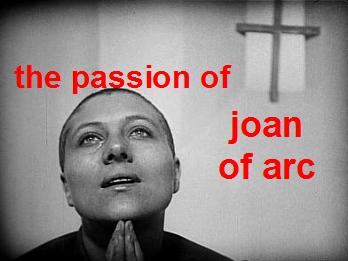
SCREENING: THE PASSION OF JOAN OF ARC

Produced in France in 1928 by Danish director Carl Theodor Dreyer, THE PASSION OF JOAN OF ARC ranks as one of the best films ever made.  Playing Joan, Renée Jeanne Falconetti's performance is frequently praised as one of the best performances ever committed to celluloid.  This was Falconetti's second film role and her last. 

The film is known for its use of the close-up to capture the pain plastered on Joan's face.  To capture a more naturalistic tone, Dreyer did not allow any actors to wear make-up and he even used a new type of film (panchromatic film) which better recorded skin tones.  The film was considered lost after the negative was destroyed in a fire, but a complete print of the original was discovered in 1981 in the closet of an Oslo mental institution.  The tense and often sadistic relationship between Dreyer and Falconetti can be seen repeated in the working relationship between Lars Von Trier and Bjork during the filming of DANCER IN THE DARK (it marked Bjork's first and final film role).

Suggested Supplemental Screenings: VAMPYR (Dreyer, 1932), GERTRUD (Dreyer, 1964), JOAN OF ARC (Fleming, 1948), ST. JOAN (Preminger, 1957), THE TRIAL OF JOAN OF ARC (Bresson, 1962), and THE MESSENGER (Besson, 1999)

Also take a look at this new and comprhensive site dedicated to the work of Dreyer.