it's the movies that have really been running things ... ever since they were invented. they show you what to do, how to do it, when to do it, how to feel about it, and how to look how you feel about it. --andy warhol
Showing posts with label screenings. Show all posts

Thursday, November 25, 2010

SCREENING: THE GREAT DICTATOR

During the transition from silence to sound, Charlie Chaplin was the last bastion of silent cinema.  In the subsequent years following the advent of sound, Chaplin had only flirted with using sound.  THE GREAT DICTATOR is is first true talkie as well as his greatest financial success and last bona fide box office hit.  The film is both hilarious and very political.  Made during a time of neutrality between the United States and Nazi Germany, THE GREAT DICTATOR was a controversial stance.  While numerous films dealing with similar anti-fascist sentiments were withheld from release, THE GREAT DICTATOR, through Chaplin's network of independent production, became an international success.  The film's production was so controversial that even the President became involved to secure its completion and release.  Chaplin, who sunk millions of his own money into the production, would have to live or die by THE GREAT DICTATOR.

Chaplin wrote, directed, produced, and starred in the film in dual roles:  a Hitler-esque dictator and a Jewish barber.  Chaplin had a strange fascination with Hitler and the film is further enhanced by the peculiar parallels in their respective biographies.  It is rumored that Hitler was sent and watched the film (twice), but his response is unrecorded.  Unlike films and propaganda at the time, THE GREAT DICTATOR is not a call to arms but rather a reminder of the humane, decent, and good.  Chaplin showcases that comedy can be profoundly serious.  Later in life, Chaplin remarked that if he had known the extent of the atrocities surrounding Nazi Germany, he would not have been able to make THE GREAT DICTATOR.

Suggested Supplmental Screenings: TRIUMPH OF THE WILL (Riefenstahl, 1935), MODERN TIMES (Chaplin, 1936), FURY (Lang, 1936), THE GRAND ILLUSION (Renoir, 1937), THE LADY VANISHES (Hitchcock, 1938), THE ETERNAL JEW (Hippler, 1940), TO BE OR NOT TO BE (Lubitsch, 1942)

Friday, November 19, 2010

SCREENING: SABOTAGE

In his famous interview with Truffaut, Hitchcock considered part of SABOTAGE to be one of his greatest mistakes, but it lives as a film that truly shows the explosive nature of film.  Released in the years leading to WWII, the film deals with a terrorist ring operating in London.  The police investigation closes in on a cinema run by a man, his wife, and her young brother.  Both political and contemplative of cinema itself, SABOTAGE shows Hitchcock at the top of his powers in Britain before his move to Hollywood in 1940.  The film stars Sylvia Sidney, a star of great beauty and depth, and Oskar Homolka as one of Hitchcock's more complex villians.  You can see SABOTAGE featured in Tarantino's INGLORIOUS BASTERDS (2009) and Sidney in BETTLE JUICE (1988) [she is one of Tim Burton's favorite actresses].

Suggested Supplemental Screenings:  Anything by Hitchcock and SCREAM 2 (Craven, 1997)

Friday, November 12, 2010

SCREENING: THE PHILADELPHIA STORY

A classic example of Classical Hollywood, THE PHILADELPHIA STORY stars three of cinema's greatest stars, Katharine Hepburn, Cary Grant, and Jimmy Stewart, under the direction of one of the greatest, if not underrated, studio directors, George Cukor.  After being labeled "box office poison," Hepburn went to Broadway to preform in Phillip Barry's play of the same name and later optioned the script for a Hollywood treatment.  With ingenious maneuvering Hepburn obtained the rights to the play and poised herself to have veto over cast, director, screenwriter, and producer.  Although Hepburn wanted Clark Gable and Spencer Tracey as her male leads, THE PHILADELPHIA STORY became a rousing success at the box office and the Academy Awards.  Representing the romantic comedy genre that feuled Hollywood in the 1930 and 1940s, THE PHILADELPHIA STORY is a quintessential example of Classical Hollywood genre and star power. 

Suggested Supplemental Screenings:  IT HAPPENED ONE NIGHT (Capra, 1934), TWENTIETH CENTURY (Hawks, 1934), MY MAN GODFREY (La Cava, 1936), THE AWFUL TRUTH (McCarey, 1937), BRINGING UP BABY (Hawks, 1938), HIS GIRL FRIDAY (Hawks, 1940), ETERNAL SUNSHINE OF THE SPOTLESS MIND (Gondry, 2004)

Friday, November 5, 2010

SCREENING: STELLA DALLAS

STELLA DALLAS, besides being amazing, shows Hollywood's transition from pre-code to prodcution code cinema as well as its continued reliance on genre and stars.  The film is the second film of the course starring Barbara Stanwyck, who ranks as one of Classical Hollywood's brightest and most talented stars.  Equal to Bette Davis, Katherine Hepburn, and Joan Crawford, Stanwyck constructed an impressive career that was supported by her versatility as much as her consistency.  She performed in comedies, melodramas, thrillers, and westerns with the greatest of ease.  Despite the variety of her performances, she played heorines and villians, she always played her parts with a strong will and intense integrity.  Stanwyck recieved four oscar nominations, and one honorary oscar, during her long career (the first for STELLA DALLAS).

The film itself represents the women's melodrama, or a maternal melodrama, which was a cornerstone of Classical Hollywood.  The film begins when Stella Martin, a working class woman, who marries up to Stephen Dallas and has a daughter, Laurel.  Stella soon learns that the upper class is not all she dreamed it would be as her husband constantly destroys her fun.  However, Laurel remains the epicenter of Stella's life.  After an embarrassing incident, Stella decides that she may be holding her daughter back from living the life Stella always wanted.  The ending ranks as one of cinema's best and leaves the audience wondering if Stella's final act is one of self-sacrifice or self-preservation.

Suggested Supplemental Screenings:  IMITATION OF LIFE (Stahl, 1934), ALICE ADAMS (Stevens, 1935), REBECCA (Hitchcock, 1940), PENNY SERENADE (Stevens, 1941), and NOW, VOYAGER (Rapper, 1942)

Also STELLA DALLAS was remade as STELLA (Erman, 1990) starring Bette Midler.

Friday, October 29, 2010

SCREENING: BABY FACE

BABY FACE, the 1933 pre-Code classic, is sexually-charged and fueled by the miraculous star power of Barbara Stanwyck.  The film follows Lily Powers ascent from a Pennslyvania speakeasy to the top of a New York company using the words of Friedrich Nietzsche for inspiration.  Pimped out by her father at a young age, Lily understands the power of her sexuality and uses it to manipulate men into giving her what she wants.  But as Lily climbs the coporate ladder, she experiences the consequences of hubris and is eventually faced with a difficult decision:  love or money.  Remember this sultry performance because we will be watching Stanwyck in a Code-era melodrama, STELLA DALLAS (1937), next week.

Suggested Supplemental Screenings:  RED DUST (Flemming, 1932), SCARFACE (Hawks, 1932) RED-HEADED WOMAN (Conway, 1932), TROUBLE IN PARADISE (Lubitsch, 1932), and anything with Barbara Stanwyck.

Friday, October 22, 2010

SCREENING: LA MATERNELLE

Supplemental Suggested Screenings:  L'ATALANTE (1934), TONI (Renoir, 1935), PÉPÉ LE MOKO (Duvivier, 1937), GRAND ILLUSION (Renoir, 1937), and THE RULES OF THE GAME (Renoir, 1939).

Friday, October 15, 2010

Friday, October 8, 2010

SCREENING: I WAS BORN, BUT ...

Directed by master filmmaker Yasujiro Ozu, I WAS BORN, BUT ... (1932) is a story about two brothers, who loose faith when they see their father bowing to his boss.  The boys suddenly realize that their father may not be the hero they imagined him to be, he may simply be human.  True to Ozu's oeuvre, the film is simple yet complex, the static camera allows for the characters to reveal themselves.  Note the distance of the camera in comparison to Deyer's camera in THE PASSION OF JOAN OF ARC.

Originally not known internationally, Ozu's work has grown in prominence outside of Japan after his death.  His influence can be seen in a variety of international filmmakers including Jim Jarmusch, Claire Denis, Deepa Mehta, and Wim Wenders to name a few.  Paul Schrader, the screenwriter of TAXI DRIVER, even wrote about the transcendent elements of Ozu's work in relation to filmmakers Robert Bresson and Carl Theodor Dreyer.

Ozu returned to I WAS BORN, BUT ... when he made a loose remake of the film in 1959 called GOOD MORNING.

Suggested Supplemental Screenings:  TOKYO CHORUS (Ozu, 1931), THE GODDESS (Wu Yonggang, 1934), and LATE SPRING (Ozu, 1949).

Friday, October 1, 2010

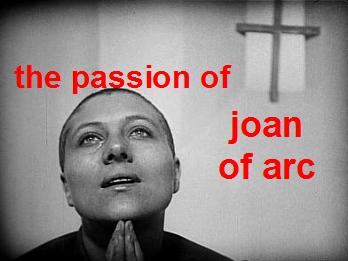
SCREENING: THE PASSION OF JOAN OF ARC

Produced in France in 1928 by Danish director Carl Theodor Dreyer, THE PASSION OF JOAN OF ARC ranks as one of the best films ever made.  Playing Joan, Renée Jeanne Falconetti's performance is frequently praised as one of the best performances ever committed to celluloid.  This was Falconetti's second film role and her last. 

The film is known for its use of the close-up to capture the pain plastered on Joan's face.  To capture a more naturalistic tone, Dreyer did not allow any actors to wear make-up and he even used a new type of film (panchromatic film) which better recorded skin tones.  The film was considered lost after the negative was destroyed in a fire, but a complete print of the original was discovered in 1981 in the closet of an Oslo mental institution.  The tense and often sadistic relationship between Dreyer and Falconetti can be seen repeated in the working relationship between Lars Von Trier and Bjork during the filming of DANCER IN THE DARK (it marked Bjork's first and final film role).

Suggested Supplemental Screenings: VAMPYR (Dreyer, 1932), GERTRUD (Dreyer, 1964), JOAN OF ARC (Fleming, 1948), ST. JOAN (Preminger, 1957), THE TRIAL OF JOAN OF ARC (Bresson, 1962), and THE MESSENGER (Besson, 1999)

Also take a look at this new and comprhensive site dedicated to the work of Dreyer.

Friday, September 24, 2010

SCREENING: THE CABINET OF DR. CALIGARI and MAN WITH A MOVIE CAMERA

This week's screening is a European double feature consisting of THE CABINET OF DR. CALIGARI, an example of German Expressionism, and MAN WITH A MOVIE CAMERA, an example of Soviet Montage.  These films showcase two very different but equally important parts of filmmaking:  mise-en-scene and montage.  Both these films and their respective movements would have tremendous impact on the art of filmmaking and especially the development of Classical Hollywood cinema that we will look at in a few weeks. 
THE CABINET OF DR. CALIGARI is considered one of the best horror films ever produced.  The film follows a series of murders in a German mountain town after the arrival of Dr. Caligari and his assistant Cesare.  With amazing sets and performances, the film takes the viewer into the deranged psyche of the human mind.  The visuals of MAN WITH A MOVIE CAMERA are equally disorienting but in a different way.  Constructed from images of Soviet citizens, with no plot, the film is an experimental documentary that features numerous cinematic techniques including double exposure, split screens, and jump cuts.

Suggested Supplmental Screenings:  For German Expressionism -- NOSFERATU (Murnau, 1922), METROPOLIS (Lang, 1927), and SUNRISE: A SONG OF TWO HUMANS (Murnau, 1927).  For Soviet Montage -- THE BATTLESHIP POTEMKIN (Eisenstein, 1925) and STRIKE (Eisenstein, 1925).

Friday, September 17, 2010

SCREENING: SILENT COMEDIES

While the feature films discussed in class are examples of melodrama, another popular genre was comedy.  This weeks screening encapsulates three of the leading silent comedians of the era:  Charlie Chaplin, Buster Keaton, and Harold Lloyd.  In the essence of time, the films by Chaplin and Keaton are short films and Lloyd's a feature film.  It is important to note that Chaplin and Keaton also produced feature films and all three were very hands-on with their productions whether they are credited as director or not.  These comedies, like the melodramas, provide entertainment as well as a window on life during that time.

You should notice a connection between these comedians and later comics such as Jerry Lewis and Jim Carrey.  Pay attention to the intricate visuals of these films since they are paramount to the successful completion of the gags.  Also of importance is the way in which each of these silent comedians honed their skills and cultivated distinctive personas that made them famous.  Chaplin, Keaton, and Lloyd were all very aware of the roles they were playing and very protective of their work, especially Lloyd (who witheld his work for decades).

Suggested Supplemental Screenings:  SHOULDER ARMS (Chaplin, 1918), THE KID (Chaplin, 1921), CITY LIGHTS (Chaplin, 1931), MODERN TIMES (Chaplin, 1936), SHERLOCK JR. (Keaton, 1924), GO WEST (Keaton, 1925), THE GENERAL (Keaton, 1926), STEAMBOAT BILL JR. (Keaton, 1928),
GRANDMA'S BOY (Lloyd, 1922), and GIRL SHY (Lloyd, 1924)

Chaplin and Keaton appear together in LIMELIGHT (1952).  We will watch Chaplin's THE GREAT DICTATOR (1940) at the end of the semester.

Surprisingly a new Charlie Chaplin film was recently discovered through ebay when a man purchased a film canister labeled "an old film," which turned out to be CHARLIE CHAPLIN IN ZEPPED, a 1916 World War I propoganda film that was considered lost.

Friday, September 10, 2010

SCREENING: THE BLOT

Directed by pioneer filmmaker Lois Weber, THE BLOT, made in 1921, is a feature film detailing issues of poverty, class, and ethics. Weber made great attempts to keep a level of realism to this family melodrama through her use of location shooting, natural lighting, and non-professional actors in supporting roles.

Weber was a director, producer, and actress. In 1914 she became the first woman to direct a feature film. She even formed her own production company in 1917. THE BLOT, which was not successfully received, marked a turning point in Weber's life, professionally and personally. The 1920s were a rough period of the director as she experienced both the loss of her company and the end of her marriage.
THE BLOT was restored by Kevin Brownlow and David Gill and showcased at the San Francisco Silent Film Festival. The restoration of Weber's work has secured her a place in the annuals of film history next to directors such as D.W. Griffith and Cecil B. DeMille.

Suggested Supplemental Screenings: BIRTH OF A NATION (Griffith, 1915), THE CHEAT (DeMille, 1915), BROKEN BLOSSOMS (Griffith, 1919), WAY DOWN EAST (Griffith, 1920)

Friday, September 3, 2010

SCREENING: LES VAMPIRES

Make sure to screen Louis Feuillade's 1915 Serial film LES VAMPIRES before Thursday.  Copies of the film can be found in the Reading Room and on hold at the Library.  You only need to watch part 4 -- Le spectre (The Ghost) (32 min). If you feel like watching the entire 399 minutes, please do.
The story will be somewhat complete and somewhat incomplete.  Consider the similarities of this format to more recent films such as the HARRY POTTER SERIES or the TWILIGHT SAGA.  These films stand on their own but they are part of a continuing story.  Serial and series films, we'll discuss the difference on Thursday, can be seen as precursors to the popularity of sequels, the development of series television, and the ubiquity of modern film marketing tie-ins.

Suggested Supplemental Screenings:  THE PERILS OF PAULINE (1914), THE HAZARDS OF HELEN (1914-1917), JUDEX (1914/1916)

Thursday, August 26, 2010

SCREENING: LUMIERE AND COMPANY

The first screening of the course is the 1995 omnibus film LUMIERE AND COMPANY.  The film celebrates the cenntienal anniversary of the Lumiere Brothers' first film by asking 40 internationally renowned driectors, such as David Lynch (BLUE VELVET, MULHOLLAND DR.), Spike Lee (CLOCKERS, INSIDE MAN), Zhang Yimou (HERO, RAISE THE RED LANTERN), and Michael Haneke (FUNNY GAMES, CACHE), to make a short film using the Lumieres' first camera.  Each film could not exceed 52 seconds, use synchronized sound, utilize more than three takes.  The process and result yeilds some interesting comments on the nature of cinema and the parallels between the Lumiere Brothers and contemporary filmmakers.

Suggested Supplemental Screenings:  TO EACH HIS OWN CINEMA (2007)